Words that make Witches
How the trials made witches of cunning women
Recent attempts to rehabilitate the (mostly) women condemned and killed in the Witch Trials of 16th and 17th century Britain have focused almost exclusively on issues of gender and class.
While these were certainly at issue - coinciding with laws that were both deeply misogynistic and brutally impoverishing to those whose lives had hitherto been in resonance with the land - what these scholars and writers have consistently ignored and devalued has been the embodied connection to inherited systems of spiritual wisdom that people at the time may also have held.
The Witch Trials - as part of a much longer history of the violent eradication of indigenous spiritual wisdom on these islands that stretches back at least as far as the Roman invasion - were extremely effective at not only extinguishing the expression of spiritual wisdom among common, or cunning, folk, but also erasing it from our cultural memory to such an extent that contemporary critics can only position the belief in the supernatural as wildly delusional and defamatory accusations against women, wives, and widows, that were solely misogynistic and economically motivated.
So it was refreshing to read this is in Carol Anne Lee’s history of the Pendle Witch Trials, Something Wicked: The Lives, Crimes and Deaths of the Pendle Witches (2024):
“But as author Emma Wilby points out in Cunning Folk and Familiar Spirits, in any such debate there is almost always a spiritual element missing, underpinned by a form of snobbery. For while historians readily acknowledge that learned and highly intellectual magicians performed rituals to facilitate mystical experience or revelation, the magical beliefs and practices of ordinary folk in this period are largely dismissed.”
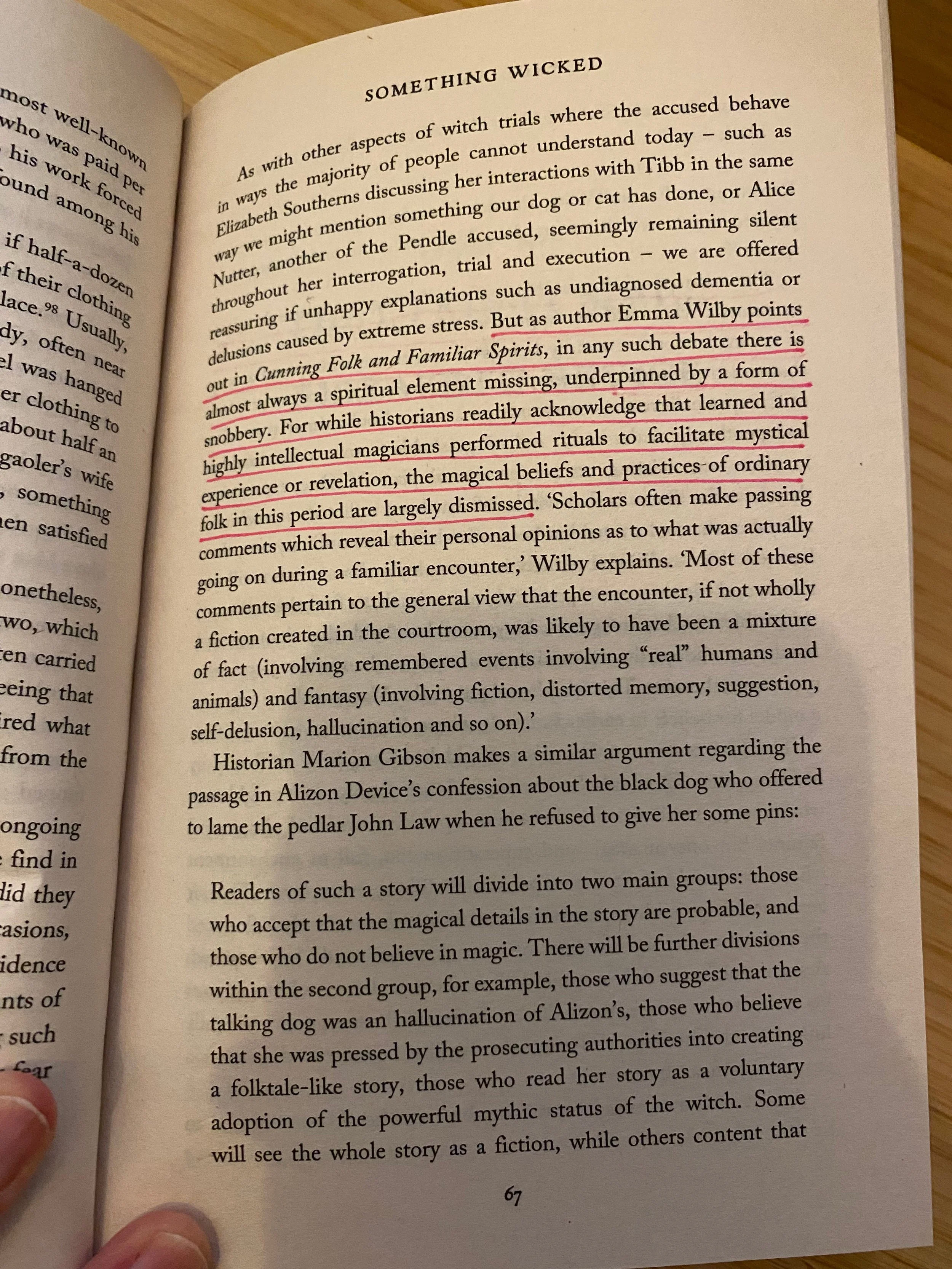
Something Wicked by Carol Ann Lee, 2025 edition: Blink Publishing.
Lee provides a well-researched and balanced approach to exploring the lives, context, and histories of the Pendle women accused of witchcraft, including the history of folk magic as practiced by the cunning folk and passed down through generations - often from grandmother to mother to daughter.
Indigenous spiritual wisdom has deep roots on this land, and it was often the women who held, nurtured, protected and shared that wisdom.
That said, as I continued to read Lee’s history, I registered that the Witches of Pendle seem to have confessed under trial to using their magic to murder various members of their own local community - which I in no way claim to be an appropriate use of these inherited skills and wisdoms. However, as cunning women, they seemed to find no wrongdoing in using their skills to protect themselves and others from those who attempted to harm, rape, or refuse them aid.
It’s interesting - also - that the charms or spells they claim to have used for their purposes were similar to or derived from common Catholic prayers and rhymes that would have been common to their ancestors until the protestant Reformation of Henry VIII that spanned the decades leading up to the 1612 trials.
These women were born into the first generations to have been violently severed from their ancestral lands by force and by law; born into the poverty that was created by appropriating and annexing the common land and resources for the accumulation of wealth by the few. Never before had people had to earn money to survive in a rigged system that extracted from their labour at an ever diminishing rate of return. Harsh laws regarding the crime of ‘poaching’ (i.e. taking from the commons what had previously been rightfully available to all) could have people killed on the third occasion of being caught.
The thirteenth century Charter of the Forest had originally restored many of the common rights to graze animals, collect firewood and forage for food, which had been severely restricted since the Norman invasion under Kings William, Richard, and John. But the Reformation and the beginnings of the Enclosures Acts in 1604 (which continued in Britain until 1914) reversed these reclamations, consolidating land ownership amongst the ruling classes and making entire generations of families dependent on money to survive, without access to the land and resources that had previously always sustained them.
Under these new laws, widowed women were no longer granted access to a proportion of their husband’s land (the life expectancy of men was typically much shorter than that of women at the time), leaving many older women - or widowed families with children - increasingly vulnerable and desperate.
Silvia Federici also writes compellingly about the origins of both capitalism and colonialism that coincide with the restriction of ordinary people’s access to land and resources, globally, and the specific introduction of laws and social systems that vilify women specifically. She traces this across lands and cultures, demonstrating how ‘Witch Trials’ have been utilised as a misogynistic means of social control from sixteenth century Europe to contemporary killings in the Global South. What she highlights is that, where land and resources are to be gained, accusations of witchcraft are an effective means of violently extracting from the most marginalised and vulnerable.
Her two books on this topic, Caliban and the Witch (2004) and Witches, Witch Hunting and Women (2018), demonstrate the historical roots and contemporary continuation of witch hunts; as well as rising resistance through women’s education, solidarity and community.
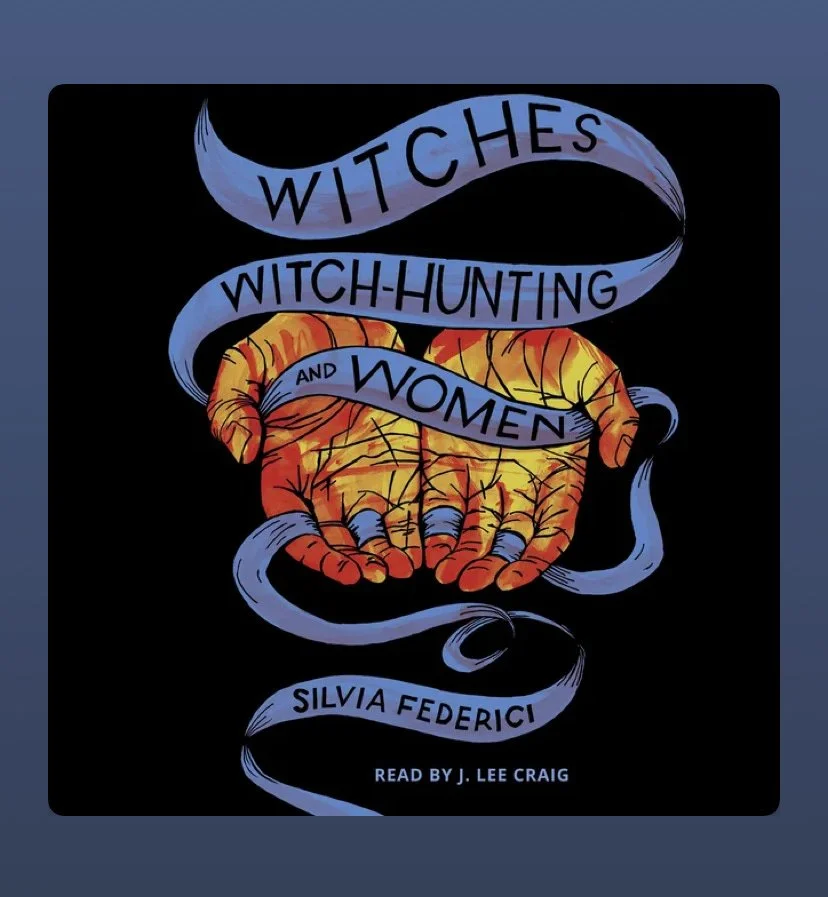
Audiobook cover: Witches, Witch-Hunting and Women by Silvia Federici.
Throughout Something Wicked, Carol Ann Lee weaves threads of analysis, gesturing towards the conclusion that the only record we have of the Pendle Witch Trials, the record compiled as The Wonderfull Discoverie of Witches in the Countie of Lancaster in 1613 by Thomas Potts, likely relies more on dramatic editing and intentional fabrication to conjure the caricature of “witch” in order to further demonise the accused.
Garbled Catholic prayers as charms, sensationalised murder claims, and selective presentation of evidence and events may have been used to ensure that the lasting impression of these women fit with the ghastly persona of the witch laid out in damning texts such as James I’s Daemonologie (1597).
Lee’s research into the evidence reads like storytelling. She walks the wild ways, sharing her insights into the places, people and powers at play in this bleak episode of British history. Threads of narrative weave and wind from chapter to chapter - opening loops of curiosity in one story that are elaborated and unpacked later in the book. It’s compelling.
And it carries us into the dark heart of a time so cruel that octogenarian cunning women, mothers, wives, and children were beaten and entombed within an airless dungeon beneath Lancaster Castle before being dragged out - crippled and lamed - for public trial, and executed on the whim of a gentry class intent upon saving itself.
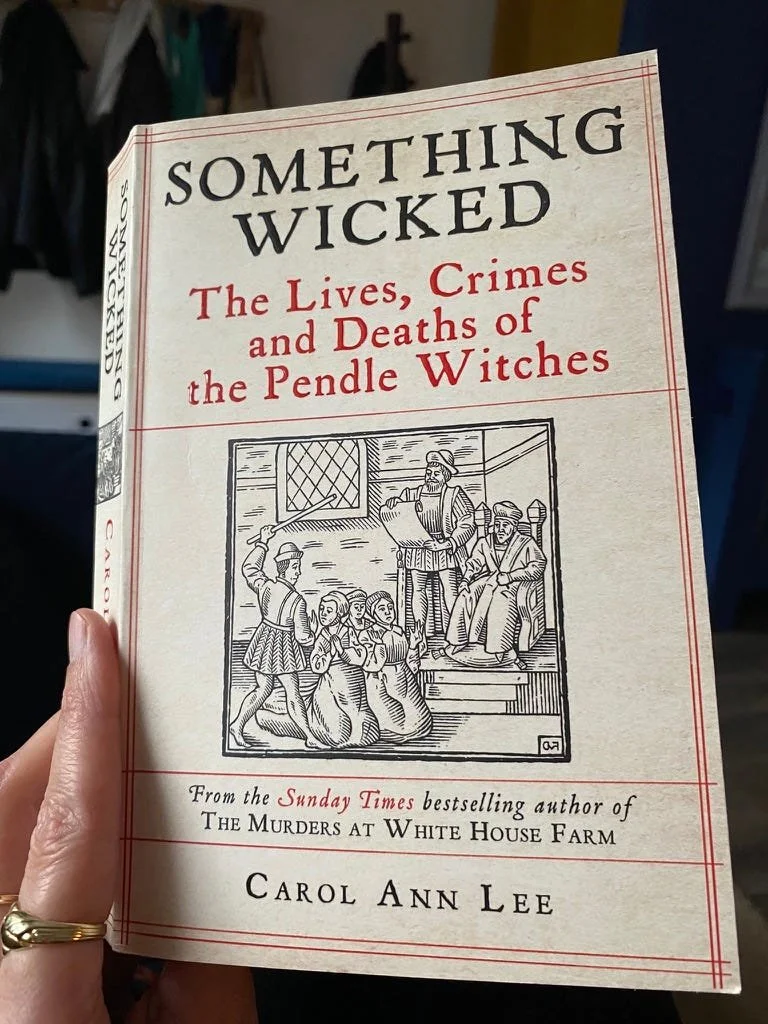
Something Wicked by Carol Ann Lee. Photo by me.
Geraldine Monk, in her 2012 poetry chapbook, Pendle Witch-Words, gives voice to the voiceless - those whose words were doctored to make their punishment fit the crime of which they were accused. She creates a series of paired monologues, with one under the popular witch-name, such as “Chattox”, and one under the given name, Anne Whittle.
It’s searing to see the name “Squintin Lizzie” paired with Elizabeth Device, having read Lee’s account of the kinds of brutality these women may have endured during their incarceration, which she suggests may have resulted in the serious facial injuries that led to the name.
For the chapbook, Monk created three new poems in a section called ‘Chantcasters’. These poems resemble chants, charms, spells; and they are given in the names of Chattox, Demdike (Elizabeth Southerns), and All. The two women she hails as the ‘octogenarian matriarchs’ lead the chants that open this book of spells. Re-invoking the names, lives, words and worlds of all those who were caught up in this dark tragedy.
What I always found striking about this collection is that, as Monk says, “all the words in these three poems, bar three lines, are reworkings of poems which Gerard Manley Hopkins wrote whilst he was in residence at Stonyhurst College” which she notes is located “in the shadow of Pendle”. She says, “I was spurred on to do this reworking by one of the guide book authors who had reproduced the rather fine three lined ‘witches spell’ and dismissed it as ‘gobbledegook’. There was no recognition that the caprice of circumstance which can make the difference between being condemned to die as a witch or being celebrated as Jesuit poet-priest could be one of time, gender and class”.
Whatever's prized and passes of us
everything that's fresh and
fast flying of us
seems to us sweet of us
and swiftly away with
done away with
undone.
From 'Chantcasters: Chattox Sings', by Geraldine Monk, in Pendle Witch-Words.
The Knives Forks and Spoons Press (2012).
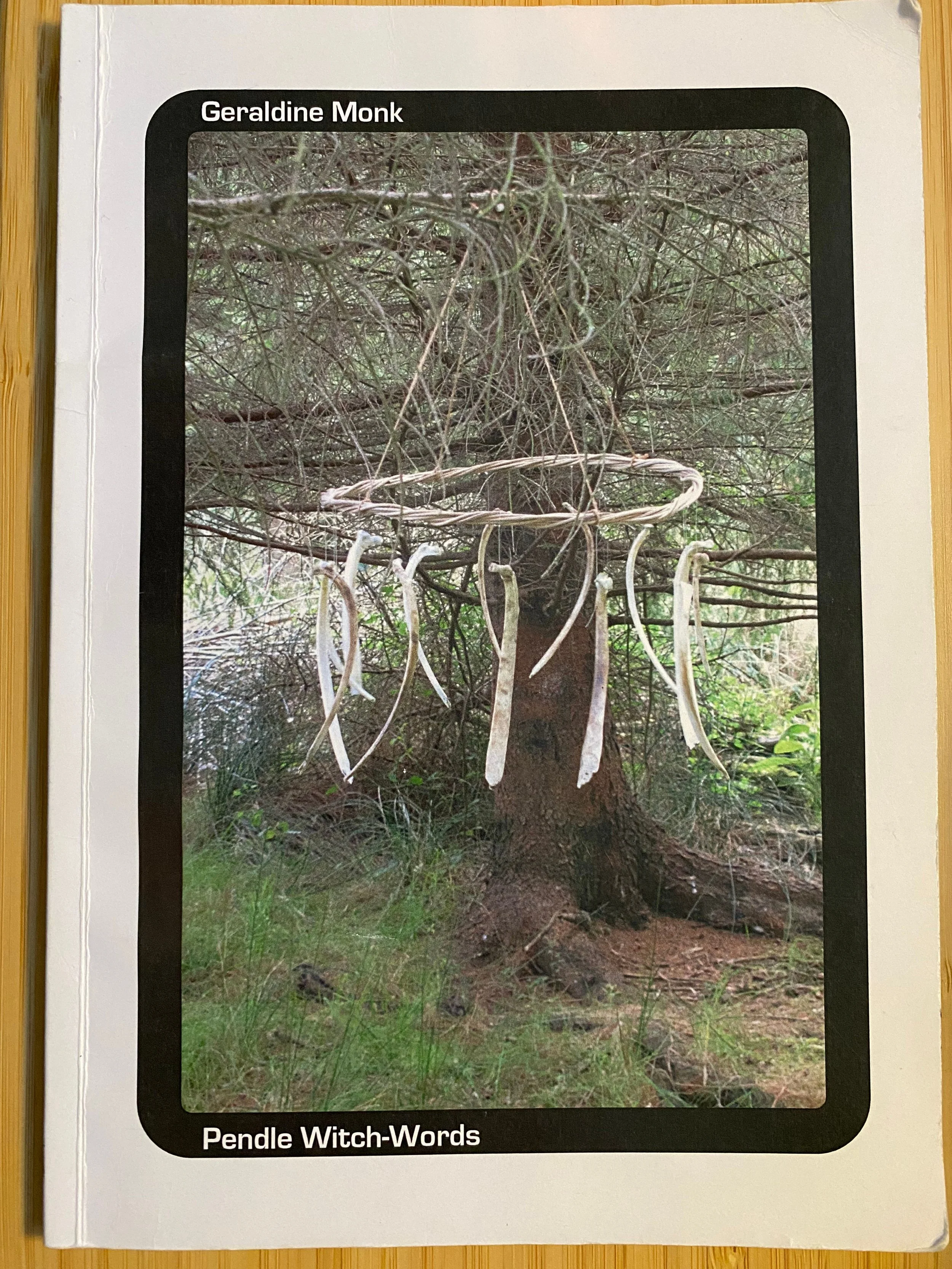
My well-read edition of Pendle Witch-Words by Geraldine Monk.